In order of discovery
The Experience of the Whole
Before there was a market, there was a maker. Before there were formal organizations to connect movers, with traders and builders, there were ideas connecting minds and hands with materials. Long before anyone wrote a mission statement, someone shaped a stone into an edge, a fiber into a thread, a thought into a tool. Ancient India used the Sanskrit word, śilpa, the ancient Greeks had, techne, in classical China there was gong, each individually meaning: craft, art, and technology. They had no need to separate these three.
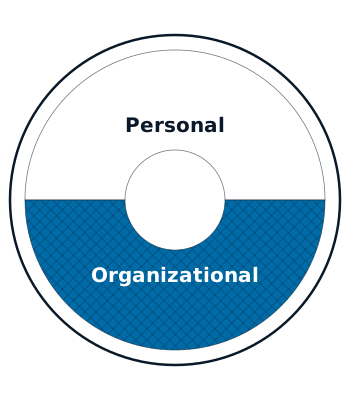
The Personal Experience
The heart of all collaborative effort is the personal experience, the perspective of the value creator, the vantage of Craft. When we tried to broaden the reach of our craft, we joined others to bring the world something it needed. At the heart of this are the people who came together to share their skills.
Today, we continue to build organizations that create and distribute value for our communities. This could be the distribution of food, tools, culture, or wealth. It could be the creation of entertainment, the gathering of knowledge, or simply to protect and defend the value that humans create. An organization allows us to pool our resources, to manage external complexities, and to collaboratively tackle challenges greater than what we could on our own.
The Organizational Experience
Yet people remain, in many ways, the purpose of the organization. Not to create an artifact, any singular person can achieve that. We organize to create value. From this the organization, or the organizational experience arises.
As a society and as individuals, we need a set of dynamics to help us create value; to resolve conflict, to facilitate creativity, and to serve as the basis of trust. The organization is the system we create to act as a steward, and the distributor of value. Today this is often the Systems vantage, but historically this was the Networks vantage.
The origin of the word company (com- meaning ‘together’, and panis meaning ‘bread’) was ‘sharing bread together.’ The eventually evolve to mean people who associate in other ways, or people carrying out a task together (militarily or business-wise).
We Grew in Complexity
Personal Experience in the Context of the Organization
Complexity cannot be understood by simplifying it away. Every edge is blurred. Every definition has exceptions. Every action and every part carries a meaning that only appears once you look at it in context.
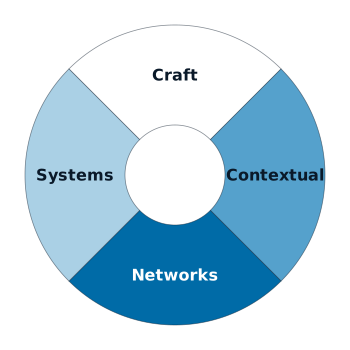
If we look at personal experience in the context of the organization a third vantage appears: the experience of human collaboration. Our struggles to sustain the system, to refine and improve our craft through shared learning, and yes, even collaborating to try and endure the system. Historically this is the Networks vantage, though more recently Networks has been relegated to a lesser role behind Systems.
While many startups and small businesses today rely on constantly evolving Networks to find and grow their customer bases, larger organizations, industries, and institutions are founded on Systems that have endured, and resisted change, for hundreds of years.
The Organization in the Context of Personal Experience
Inverting this, we can view the organization in the context of personal experience, and we find the experience of value (the value of human effort); its journey through the topography of the organization from negotiation to creation, and the journey back, as the feedback path that closes the loop. This is the context in which we create and determine what is of value, who it is value for, how, and when; both as consumers of value, and as creators. This is the Contextual vantage.
Bridging Our Way Back to a Whole
A Small-Picture View
The Craft and Contextual vantages are often guilty of navel-gazing. These are the perspectives that see the trees as the reason why the forest is a forest. While they are both microcosms of the whole, they are also very much a small-picture view. They present to us the tactical or technical levels of scope.
A Big-Picture View
On the other hand, the Networks and Systems vantages are often guilty of star-gazing. These perspectives see the forest that has lost one of its trees as the same forest. While they are both macrocosms of the whole, they are also very much a big-picture view. They present to us the more operational or strategic levels of scope.
Neither perspective is wrong, just often misaligned. Their perspectives are shaped by the priorities of the roles we assign to them; the priorities that we ask them to have, and need them to maintain.
A Whole-Picture View
So one more vantage is needed to be complete. A vantage that sees the whole-picture. A perspective that sees how the small picture and the big picture are each incomplete on their own, and prioritizes a view of the whole. This is the vantage of Coherence.
Coherence sees the tension inside every other vantage, not to resolve it away, but to keep it in balance:
- Craft needs to be free to create, but also needs to deliver value in a way that sustains the system, not simply find itself sustained by it.
- Contextual needs value to flow to the customer, internal and external alike, but not so freely that we lose sight of the organization’s purpose, or of our impact further downstream.
- Networks needs to coordinate and connect, but not at the cost of becoming an end in itself, coordination that serves nothing beyond its own upkeep.
- Systems needs to steward value at scale, but not so much that its own structure becomes more important than what that structure was built to protect.

Machines replicate, computers imitate, humans innovate
Networks was the original organizational experience. It was messy. It was complex. It was difficult to predict, or to replicate, or to control. It is also a journey of connection, of things that have value; a story of people coming together to share bread.
Our informal connections eventually became codified by laws, and social mores. As societies and organizations grew larger it became easier to change workflows and processes into predictable value generators. As we treated organizations and the people in them like machines, and later as computers, we shifted increasingly to put Systems at the helm of our organizations. This made them accountable for our actions, not us. It also made organizations rigid and incapable of adapting and navigating a changing world, the way networks had already evolved to do. Entire industries like Agile, have arisen to oppose this spreading organizational rigor mortis.
Restoring the network vantage to the central position along with a cohesive vantage of the whole, and the grand strategic, far-seeing, and far-thinking scope is key to creating a continuously adaptive, resilient, and enduring organization; one that generate value generations into the future.
Building an Understanding of the 5 Vantages
Scale, Value engine, Common Tempo and Scope
How wide each vantage sees as a complete view of the organization, the part of the value engine it runs, the tempo it often keeps, and the depth at which it most commonly works.
Vantage | The Scale (Lens) | The Value Engine | Tempo | Depth of Scope |
|---|---|---|---|---|
Craft | Small-Picture View (The Human Foundation) | The Value Creator (Individual creativity and production) | Responsive / Fluid (Bi-weekly to Daily) | Technical (Mind, Hands, Materials) |
Contextual | Small-Picture View (The Landscape) | The Value (Customers and value loops) | Accelerated (Monthly to Weekly) | Tactical (Team) |
Systems | Big-Picture View (The Engine) | The Value Engine (Budgets, assets, policy code) | Steady (Quarterly to Monthly) | Operational (Functional / Department) |
Networks | Big-Picture View (The Ecosystem) | The Creator Engine (Synergy, synthesis) | Collaborative (Semi-annual to Quarterly) | Theater (Value Stream) |
Coherence | Whole-Picture View (The Summit) | The Value Ecosystem (Core myth and long-term lore) | Perennial / Slow (Annual / Generational Horizon) | Grand (Enterprise / Ecosystem) |
Flow
What each vantage sends out, what returns to it, and who it serves inside and outside the organization.
Vantage | The Flow (Active) | The Ebb (Return) | Internal | External |
|---|---|---|---|---|
Craft | Control (Agency and control of tools and means) | Mastery (Tactile resistance updating skill) | The individuals: (Intrinsic motivation, skills, personal purpose) | The Community & Culture (Human needs, societal desires, collective purpose) |
Contextual | Value (Delivering user solutions) | Feedback (Loop-closing user response) | Internal Customer: (Psychological safety, growth, livelihood, mastery) | External Customer: (Products, services, utilities, solutions) |
Systems | Capital & Rewards (Allocating resources) | Throughput Velocity (Energy-to-output conversion) | The Organizational Design (Workflows, structures, internal value distribution) | The Market / Institution (Economic structures, societal frameworks that host the org) |
Networks | Power (Mobilizing relationships) | Trust (Validation of structural safety) | Internal Networks (Peer support, HR, internal training, resource pools) | External Supply Networks (Suppliers, retailers, distributors, partners) |
Coherence | Alignment (Holding the North Star) | Resonance (Integrity, detecting hypocrisy vs. truth) | The Producer Persona (The human acting as an economic agent of creation) | The Consumer Persona (The human acting as a social agent of consumption / feedback) |
Focus
Each vantage has a focus and a core tension that it is tasked with balancing.
Vantage | Strategic Focus & Dynamic | Core Tension / Mirror |
|---|---|---|
Craft | Mastery & Execution: Focuses on the meticulous construction, specific requirements, and completion of a single, discrete unit of work. | The Spark: Individual creativity vs. Collective human need (The key and the lock). |
Contextual | Market Flow & Mobility: Coordinates the end-to-end flow of value to the customer across changing external environments and market conditions. | The Exchange: Sustaining the makers vs. Satisfying the market. |
Systems | Process & Infrastructure: Designs repeatable logic loops, cross-functional frameworks, and structural guardrails to scale execution. | The Infrastructure: How value flows internally vs. How value is hosted and distributed globally. |
Networks | Relational Proximity & Trust: Leverages informal human connections, psychological safety, and high-frequency communication channels within local groups. | The Ecosystem: The internal network that feeds the engine vs. The external network that scales it. |
Coherence | Identity & Alignment: Manages long-term organizational identity, macro-positioning, and the tension between background purpose and foreground priorities. | The Ultimate Synthesis: The reality that the employee inside the building and the citizen outside are the same person. |
Viable Systems
The inner and outer worlds each vantage works within: the microcosm inside the organization and the macrocosm around it.
Vantage | Internal Microcosm (The Inside) | External Macrocosm (The Outside) |
|---|---|---|
Craft | The Value Creator The autonomous frontline cells, teams, and individuals executing the primary work. | The Localized Consumer The immediate, real-world end-user interacting directly with the product or service. |
Contextual | The Internal Customer The internal workforce’s capacity, tools, well-being, and readiness to adapt. | The External Market & Culture Future trends, competitive threats, macro-environmental shifts, and societal pain points. |
Systems | The Internal Workflows The immediate operational structures, command channels, and resource distribution. | The Immediate Operating Environment Local regulations, day-to-day market constraints, and immediate industry standards. |
Networks | The Internal Support Networks Shared standards, HR protocols, communication platforms, and resource-conflict resolution. | The External Logistics Ecosystem The networks of suppliers, distributors, protocols, and retail platforms that anchor the industry. |
Coherence | The Organizational Ethos The unified core identity, overarching values, and strategic purpose. | The Ultimate Purpose The organization’s “Social License to Operate” and its ethical contract with society. |
Cybernetics
Where each vantage sits in Stafford Beer’s Viable System Model, and the cybernetic job it does there.
Vantage | Viable System Model | The Cybernetic Synthesis |
|---|---|---|
Craft | System 1 (Operations & Execution) | The Fractal Cell: Where the rubber meets the road. System 1 cells are fully autonomous, self-contained viable systems that absorb local complexity through direct decisions. |
Contextual | System 4 (Intelligence & Strategy) | The Periscope: Treats the internal capability and external environment with equal weight to prevent the innovator’s blind spot. |
Systems | System 3 (Control) | The Present: Manages the operational “now.” It relies on strict audit loops to pierce the algorithmic illusion of corporate dashboards. |
Networks | System 2 (Coordination & Infrastructure) | Network Harmonization: internally prevents teams from fighting over shared resources; externally, it syncs the company to the logistics and standards of the broader network without bloat. |
Coherence | System 5 (Policy & Identity) | The Anchor: Holds the absolute systemic identity. It balances the tension between what the organization is doing today (System 3) and what it must become tomorrow (System 4). |
Need and Gestalt
What each vantage needs psychologically, and the Gestalt principle behind how it sees. Gestalt principles explain how our brains organize parts into a complete picture.
Vantage | Psychological Need | Gestalt Principles |
|---|---|---|
Craft | Competence & Autonomy (Personal agency over work) | Closure: our brains fill in the missing pieces of an incomplete shape to see an object as a complete whole. |
Contextual | Spontaneity & Identity (Relevance, play, and seeing work matter to a user) | Continuity: our eyes prefer to follow the smoothest, most continuous path rather than abrupt or broken lines. |
Systems | Security & Fairness (Clear rules and structural backing) | Similarity: we naturally group elements that look alike, similar colors, shapes, or sizes, together as a single concept. |
Networks | Secure attachments & Freedom to express (Feeling safe with the group) | Proximity: objects that are close to each other are perceived as a single, unified group rather than individual items. |
Coherence | Self-coherence (Integrated sense of identity) | Figure-Ground: we separate images into a foreground (the main object) and a background (the surroundings) to make sense of what we are seeing. |
Bias and Blind Spot
The bias each vantage leans toward, and the blind spot that tends to come with it.
Vantage | Dominant Bias | The Operational Blind Spot |
|---|---|---|
Craft | The Sunk Cost Fallacy (Finishes a flawed plan just because they started it.) | Local Optimization (Builds a flawless component that doesn’t fit the product architecture.) |
Contextual | Recency Bias (Alters strategy based on the most recent customer or market signal.) | Strategic Whiplash (Outpaces the internal infrastructure, causing delivery mechanisms to collapse.) |
Systems | The Maslow’s Hammer / Functional Fixedness Bias (Treats human or cultural friction as a broken process to fix with a rule.) | Process Fetishism (Standardizes workflow until the culture suffocates and top talent exits.) |
Networks | In-Group Bias / Affinity Bias (Trusts the echo chamber of the immediate circle over outside reality.) | Relational Insularity (Shuts out critical objective truth because it didn’t come from the trusted loop.) |
Coherence | Confirmation Bias (Distorts the context to force data to fit their chosen narrative frame.) | Ivory Tower (Issues grand corporate manifestos that are completely unexecutable on the ground.) |
Architecture
Each vantage as a drawing scale and a blueprint, from the urban master plan down to the material joint.
Vantage | Architectural Scale | Engineering Blueprints |
|---|---|---|
Craft | 1:1 to 1:10 (Detail Scale) | The Material Joint: Meticulously specifies exactly how wood meets steel. Focuses entirely on the execution, quality, and fabrication of the individual artifact. |
Contextual | 1:20 to 1:50 (Room Scale) | The Common Space: Maps the local layout of furniture and close human proximity. It designs how a small group of people gather, talk, and move together. |
Systems | 1:100 to 1:200 (Building Scale) | The Structural Grid: Lays out the plumbing blueprints, electrical grids, structural concrete pillars, and repeatable rules governing the layout. |
Networks | 1:500 (Site Scale) | The Environmental Flow: Traces how the structure interacts with real-time property lines, external roadways, passing traffic, and the external climate. |
Coherence | 1:1000+ (Urban/Zoning Scale) | The Master Plan: Zooms completely out to ensure the entire silhouette makes visual sense against the background city skyline, historical identity, and macro laws. |
Contemporary Traditionalism
From a contemporary standpoint, existing traditions and elder wisdom have a lot to offer current and future generations. Much of the current model is influenced by First Nations organizational models.
| Vantage | Contemporary Traditionalism |
|---|---|
| Craft | Individual: craft is an act of legacy, excellence begins with accountability. We do not hide behind a team; the individual brings their raw, uncompromising mastery to the field, carving their work with the realization that they are tomorrow’s ancestors. |
| Contextual | Mutual: value at this vantage is explicitly negotiated with the external customer and the living environment, Mutual highlights that a business cannot survive by dominating its habitat; it must enter a balanced, reciprocal loop with it. |
| Systems | Ritual bridges the gap between mechanical “systems” and living rhythms. Teams do not just follow software protocols; they participate in the organizational Ritual (daily, bi-weekly, monthly) to entrain their energies to the market. |
| Networks | Dividual: through proximity and resonance, boundaries between modern teams are blurred. Information, strategies, and code shortcuts ripple through a shared web of interconnected players who amplify and co-author the workflow. |
| Coherence | Continual: the permanent, underlying field that locks the entire decentralized network together. It is the invariant digital trail that flows endlessly through the organization, keeping it whole despite the shifting shapes |
Organizational Geometry
The geometric structure each vantage favors, from symmetrical hierarchy to asymmetric fractal.
| Vantage | Organizational Geometry |
|---|---|
| Craft | Fractal: (focused execution) a master artisan or local micro-team can focus purely on mastering their immediate execution block, confident that their local excellence perfectly mirrors and reinforces the global architecture. |
| Contextual | Tessellation: requires shapes to fit together perfectly edge-to-edge without overlap or gaps, it demands an awareness of external boundaries, environmental fit, and adjacent market interfaces. |
| Systems | Symmetrical Hierarchy: Modern hierarchies design rigid structures first, then force human beings into the slots, prioritizing uniform processes over fluid human dynamics. |
| Networks | Fractal Tessellation: Teams can instantly plug into, communicate with, and cross-pollinate other teams because they share the same underlying geometric DNA. |
| Coherence | Asymmetric Fractal: The end-state (unified harmony). When a business can stretch, compress, and accelerate different units at totally different tempos, it can no longer rely on rigid rules for alignment. |
Generative Strength
What each vantage contributes when it is cultivated, not just repaired.
| Vantage | Generative Strength |
|---|---|
| Craft | Technical Craftsmanship: protecting individual focus to generate deep domain expertise, high-quality output, and real operational precision. |
| Contextual | Adaptive Innovation and Wayfinding: reading the environment, anticipating disruption, and adjusting a team’s posture to seize opportunities a static plan wouldn’t have anticipated. |
| Systems | Architectural Design: building and continuously tuning the repeatable workflows, internal tooling, and infrastructure that prevent operational friction, treating process itself as a craft worth real attention. |
| Networks | High-Trust Collaboration: decoupling fear from team boundaries, so communication, feedback, and cross-pollination happen organically instead of defensively. |
| Coherence | Systemic Stewardship and Co-Creation: aligning the goals of every vantage to the purpose of the organization. Enrolling the external communities to work in synchrony with the internal. The serve as a guide for conflict and collaboration. |
Product Pentad
The product-team role behind each vantage: four legs, plus the stool they support.
| Vantage | Product Pentad (The Four-Legs + the Stool) |
|---|---|
| Craft | Human-Centered Craft: Human Safety, Health, & Behavior |
| Contextual | Software / Mechanical Engineering: Feasibility & Technical Foundation |
| Systems | Product Management (PM): Viability & Business Strategy |
| Networks | Product / UX / UI Design: Desirability & User Experience |
| Coherence | Head of Product Experience / Product General Manager (GM): Systems Architect, Harmony & Experience |
Grouping by Role
The goal and focus of each vantage when teams are grouped by role or function.
| Vantage | Grouping by Role / Function |
|---|---|
| Craft | Goal: Technical mastery, material manipulation. Focus: Execution, creation, deep domain expertise, and high-quality outputs. |
| Contextual | Goal: User/client satisfaction and problem resolution. Focus: immediate client pain points, rapid adaptation. The customer, and the immediate delivery of value. |
| Systems | Goal: Operational efficiency, predictability, and structural durability. Focus: Scale, infrastructure, policies, standard operating procedures, and long-term stewardship. |
| Networks | Goal: The elimination of silos and speed of communication between nodes. Focus: Relationships, pathways, alignment, communication flow, and lateral coordination. |
| Coherence | Goal: long-term organizational alignment and balanced tensions. Focus: strategic synthesis, managing natural frictions, and protecting the core purpose. |
The Diátaxis framework
Organizes technical documentation into four distinct quadrants based on two axes: Action vs. Cognition (vertical axis) and Study vs. Work (horizontal axis).
| Vantage | Grouping by Role / Function |
|---|---|
| Craft | Tutorials (Learning-Oriented / Study + Action) Practical and learning-focused. To help the user learn by doing and acquire skill or confidence. |
| Contextual | How-to guides (Task-Oriented / Work + Action) Practical and goal-driven. To help the user get work done by solving a specific, real-world problem. |
| Systems | Technical reference (Information-Oriented / Work + Cognition) Theoretical/propositional knowledge applied to work. To provide accurate, neutral facts and technical descriptions so the user can look up details while working. |
| Networks | Explanation (Understanding-Oriented / Study + Cognition) To deepen the user’s understanding and clarify the “why” behind concepts, design choices, or history. |
| Coherence | The total documentation landscape: an integrated ecology where the whole is greater than the sum of its quadrants. |